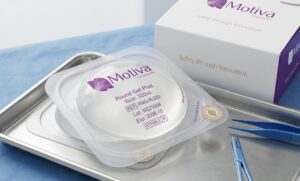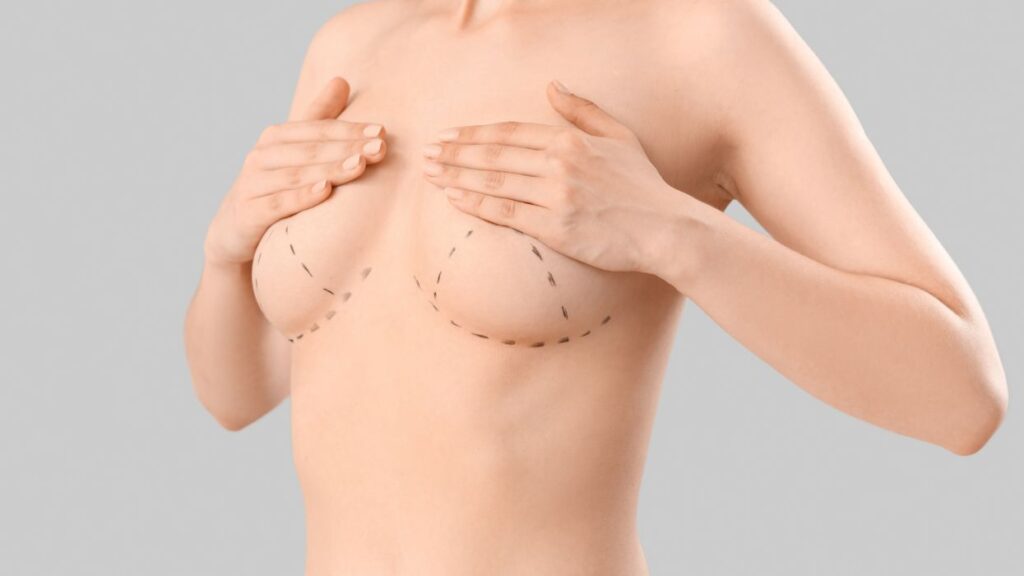
Most patients spend months researching implant sizes, incision types, and recovery timelines. But there’s one technique quietly reshaping long-term breast surgery outcomes that rarely gets the spotlight it deserves: the internal bra.
It’s not a standalone procedure. It’s a supplementary technique performed during breast surgery to do something no external bra ever could. It supports your results from the inside out by adding longer-term internal support during breast surgery.
Here’s what you’ll find in this guide:
- What the internal bra actually is and what it isn’t
- How the technique works and what materials are used
- Which breast procedures it’s typically combined with
- Who makes a good candidate
- What recovery looks like and how long results last
- Risks, limitations, and honest questions to ask your surgeon
Our surgical approach at Aestira is built around results that age well, not just look good on day one. Whether you’re considering a breast lift, augmentation, or a lift and augmentation combined, this is exactly the kind of detail worth understanding before your consultation.
What Is The Internal Bra And What It Isn’t
The name sounds deceptively simple. But the internal bra is one of the more nuanced tools in modern breast surgery, and a lot of patients walk into consultations with the wrong picture in their heads.
Let’s clear that up.
The internal bra is not a standalone procedure. It’s a supplementary technique used during breast surgery to reinforce your results structurally. Think of it less like an operation and more like an upgrade added to an existing surgical plan.
So What Actually Is It?
At its core, the internal bra describes a range of surgical techniques that improve breast shape and stability using a mesh scaffold. Depending on the case, surgeons may use absorbable mesh, biologic mesh, internal sutures, or a combination of these techniques to reinforce the breast’s natural support and improve long-term stability.
Over time, the mesh encourages your body to produce new collagen fibers that strengthen the breast’s natural support structure. As the mesh dissolves, it leaves behind a robust framework of your own tissue that maintains the lifted position.
What It Is NOT
This is where patients often get confused:
| Common Misconception | Reality |
|---|---|
| It’s a type of implant | It’s a biocompatible scaffold, not a silicone implant |
| It replaces a breast lift | It enhances a lift, not substitutes it |
| It’s permanent hardware | Most mesh types are fully absorbable over 18-24 months |
| It’s a new experimental trend | It has been used in reconstructive surgery for years |
The Two Main Forms
- Absorbable mesh (e.g., GalaFLEX): Dissolves over 18-24 months while your tissue builds its own support framework around it
- Internal suturing techniques: Reinforced stitching that tightens and repositions internal breast structures without mesh material
The right approach depends entirely on your anatomy, tissue quality, and what your breast surgery is designed to achieve.
How the Technique Actually Works
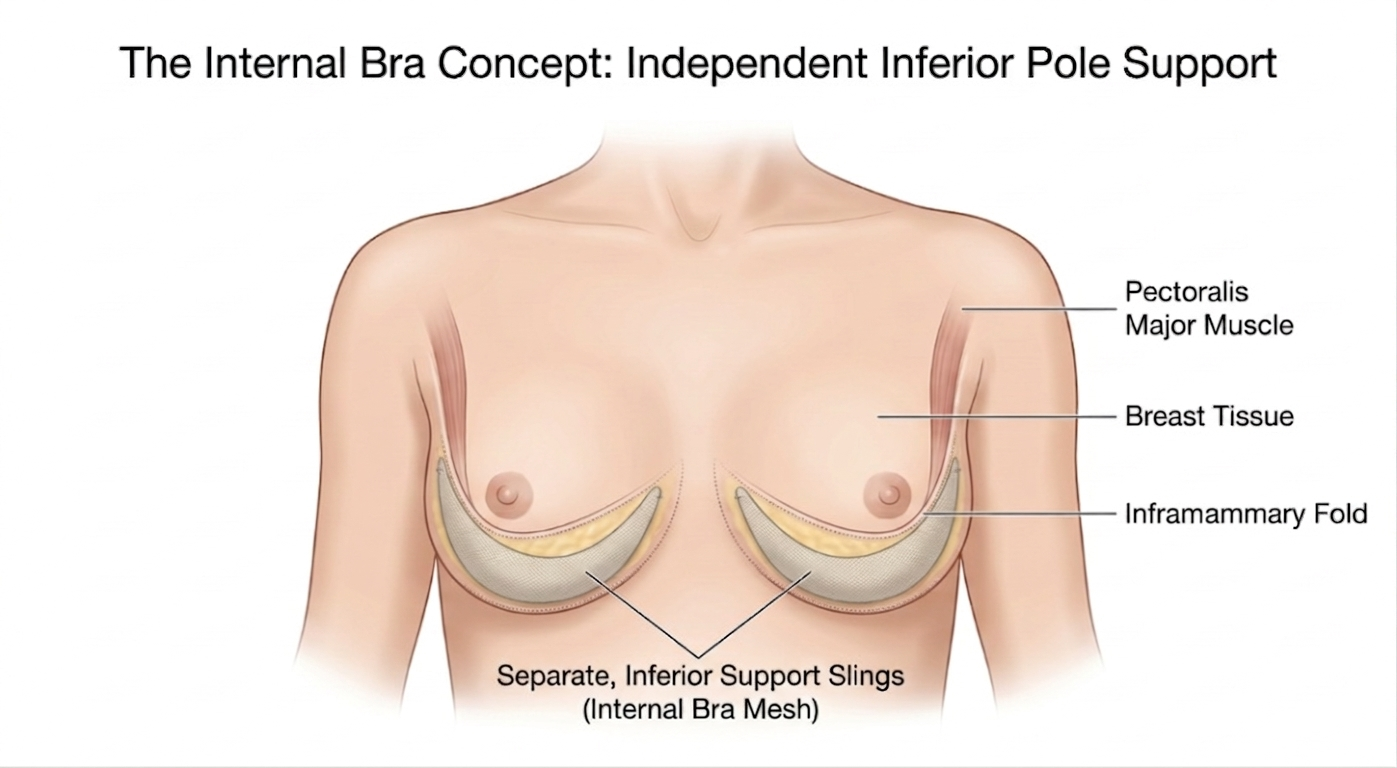
The surgical process is more straightforward than the name suggests. During your breast surgery, your plastic surgeon places a biocompatible scaffold or supportive mesh inside the breast, anchoring it to the chest wall to create what functions like an internal hammock. This reinforces the lower pole of the breast and the inframammary fold, the two areas most vulnerable to long-term sagging.
Surgeons can create this internal support structure using sutures, mesh materials, or a combination of both. The approach depends on your anatomy, tissue quality, and the complexity of your breast surgery.
The Materials Used
| Material Type | How It Works | Best For |
|---|---|---|
| Absorbable mesh (e.g., GalaFLEX) | Dissolves over 18-24 months; body builds collagen around it | Most cosmetic breast surgery cases |
| Biologic mesh (e.g., Strattice) | Derived from natural tissue; integrates permanently | Complex revision or reconstructive surgery cases |
| Internal sutures | Reinforced stitching anchored to chest wall or fascia | Mild to moderate cases needing add support |
Pro tip: GalaFLEX, one of the most widely used scaffolds, is made from poly-4-hydroxybutyrate (P4HB). As it dissolves, it leaves behind a collagen framework that can be up to four times stronger than natural tissue. That’s the real value proposition here. It’s temporary material creating permanent structural support.
Procedures It’s Typically Combined With
The internal bra is not procedure-specific. It’s a technique layered onto your existing surgical plan. Here’s where it fits most naturally:
- Breast lift: The most common pairing. Adds internal support to a mastopexy so the results hold longer against gravity and the natural aging process
- Lift and augmentation: Particularly useful here since breast implants add weight, and soft tissue needs extra reinforcement to prevent implant displacement or implant malposition over time
- Breast augmentation: Used prophylactically in patients with naturally weak or stretched skin to prevent bottoming out
- Breast reduction surgery: Helps maintain shape after significant tissue removal, especially in women with heavy breasts
- Breast revision surgery: A strong candidate for patients with existing implants experiencing recurrent breast ptosis or implant malposition
- Breast reconstruction: Used in reconstructive surgery to rebuild and stabilize soft tissue after mastectomy
Who Makes a Good Candidate
Not every patient needs the internal bra. The internal bra is used selectively based on anatomy and tissue strength. Not every patient needs this added reinforcement.
You’re likely a strong candidate if you:
- Have significant breast sagging (breast ptosis) from the natural aging process, weight loss, or pregnancy
- Have naturally thin, weak, or stretched skin with poor tissue elasticity
- Are getting larger breast implants and want a stable foundation to support them long-term
- Have a history of implant displacement or bottoming out after prior augmentation procedures
- Are undergoing revision surgery and want to prevent complications from recurring
- Are in good health with no active infections or uncontrolled medical conditions
You may not be a candidate if you:
- Are planning future pregnancies, which can compromise breast shape regardless of the technique
- Have a BMI significantly above the healthy range
- Have certain tissue healing conditions that increase mesh-related risks
During consultation, your surgeon evaluates skin quality, breast weight, and surgical history to decide if this additional support makes sense for you. At Aestira, Dr. Zeng builds every surgical plan around your specific anatomy and long-term goals, not a one-size-fits-all protocol. You can book a consultation here to explore whether this technique fits your picture.
What Recovery Looks Like

Recovery from an internal bra breast lift follows the same general arc as standard breast surgery. The mesh works quietly in the background while your body heals.
General recovery milestones:
| Timeline | What to Expect |
|---|---|
| Week 1 | Rest, pain medication as needed, limited mobility |
| Weeks 1-2 | Light desk work possible; avoid heavy lifting and strenuous exercise |
| Weeks 3-4 | Gradual return to light activity; supportive bra worn consistently |
| Weeks 4-6 | Most patients resume light lower body exercise |
| 6+ weeks | Cleared for unrestricted exercise based on surgeon assessment |
Most patients do not find that recovery is significantly longer or harder than a lift or augmentation without mesh, but they may benefit from a more stable result over time.
A few things most patients don’t expect:
- Swelling and firmness take longer to fully resolve than with standard augmentation procedures
- Your final breast shape won’t be fully visible until the mesh integrates and swelling subsides, often 3-6 months post-surgery
- Wearing a supportive bra during recovery is non-negotiable for the best results
Our wellness and recovery protocols at Aestira are designed specifically to reduce inflammation, accelerate healing, and support your body through this process. That includes biostimulation therapies and nutritional guidance that most standard practices simply don’t offer.
How Long Do Results Last?
This is the question most patients actually care about. Traditional breast lifts typically hold well for 5-7 years before gravity begins to reassert itself. With the internal bra technique, results typically extend to 10-15 years, with reduced revision needs and stronger internal support preventing common complications.
That said, factors like significant weight fluctuations, pregnancy after surgery, and natural aging will still influence longevity regardless of technique.
Risks, Limitations, and What to Ask Your Surgeon
Balanced information matters in cosmetic surgery. The internal bra has real advantages, but it also carries risks patients deserve to know upfront.
Risks Worth Knowing
Potential complications include infection, seroma (fluid collection), bleeding, hematoma, inflammation, scaffold migration, and wound healing issues. These risks are generally low in well-selected patients with an experienced surgeon, but they’re not zero.
Importantly, in November 2023, the FDA released a safety communication noting that no surgical mesh products are currently cleared or approved specifically for use in breast surgeries. This doesn’t mean the technique is unsafe when performed thoughtfully, but it does mean the conversation with your surgeon matters enormously. Many materials used for the internal bra are cleared for other soft tissue applications and used off-label in breast surgery, which is a standard and legal medical practice.
Systematic reviews show that when mesh is used thoughtfully in aesthetic surgery, complication rates remain acceptable and are often offset by improved long-term support.
Questions to Ask Your Surgeon

Are you board-certified or board-eligible in plastic surgery, with residency training in plastic surgery?
This is the foundation. The internal bra technique demands precision. A surgeon’s skill directly determines whether complications arise or outcomes hold.
What mesh material do you recommend for my anatomy, and why?
Synthetic mesh and biologic mesh carry different risk profiles and longevity outcomes. The answer reveals how personalised your surgical plan actually is.
Have you accounted for my natural aging process and future weight changes in this plan?
No internal support structure is immune to significant life changes. A thorough surgeon factors these into candidacy and expectation-setting upfront.
What does your post-surgical wellness protocol look like?
Recovery support is where many practices fall short. Ask specifically about inflammation management, activity restrictions, and whether integrative wellness therapies are part of your plan.
What financing options are available?
Breast surgery with internal bra support is a significant investment. Ask about CareCredit and PatientFi options before committing to a surgical plan.
What to Expect at Your Consultation
Your consultation is where everything clicks into place. A board-certified plastic surgeon will assess your breast tissue, skin quality, body type, and history to determine whether the internal bra procedure fits your aesthetic goals.
Most patients come in knowing they want something done about excess skin or stretched skin from weight loss, pregnancy, or natural aging. What they don’t always know is which of the different surgical techniques will actually deliver the aesthetic outcomes they’re picturing. That’s exactly what this conversation is for.
Here’s what a thorough consultation should cover:
- Your tissue quality: Natural breast tissue strength determines how much extra support you actually need
- Your procedure fit: Whether breast reduction, breast reduction surgery, augmentation, or a lift is the right base procedure
- Your recovery expectations: Many patients underestimate downtime. Plan to avoid strenuous exercise for several weeks. Recovery time varies, but most patients resume light activity within a few weeks
- Your support strategy: Whether absorbable material, biologic mesh, or internal sutures will best provide additional support for your anatomy
- Your long-term plan: A good surgeon factors in future weight changes and aging to help prevent sagging from recurring
At Aestira, Dr. Zeng’s consultations are built around improved support for your specific anatomy, not a generalised approach. Whether you’re exploring a breast lift, reduction, or revision, the goal is always results that feel natural and last. Book your consultation to get started.
Your Breast Results Deserve to Last. So Does Your Care at Aestira.
The internal bra is one of the most meaningful advances in modern breast surgery, not because it’s flashy, but because it quietly solves a problem most patients don’t discover until years post-op. Understanding it before your consultation puts you in a far stronger position.
Key takeaways:
- The internal bra is a supplementary technique, not a standalone procedure
- It uses absorbable mesh or internal sutures to reinforce soft tissue from within
- It pairs with breast lifts, augmentations, reductions, and revision surgeries
- Best candidates have loose tissue, breast ptosis, or history of implant displacement
- Recovery mirrors standard breast surgery, with results lasting up to 10-15 years
- Surgeon skill and patient selection are the two biggest factors in outcomes
At Aestira, Dr. Zeng approaches every breast procedure with the same attention to long-term results that the internal bra technique itself represents. From your first consultation through our integrative recovery protocols, every decision is made with your outcome in mind. Book your consultation and find out if this technique belongs in your surgical plan.
FAQs
Is an internal bra painful?
Discomfort is manageable with pain medication. Most patients report soreness similar to standard breast surgery. Recovery time is a few weeks.
Is an internal bra better than a breast lift?
Neither replaces the other. The internal bra procedure provides additional support within a breast lift, improving aesthetic outcomes and helping prevent sagging longer.
Is an internal bra covered by insurance?
Rarely. As an aesthetic plastic surgery technique, this surgical procedure is typically out-of-pocket. Exceptions apply if combined with breast reconstruction. Financing options like CareCredit and PatientFi are available.
How long do internal bras last?
The absorbable material dissolves within 18-24 months, but the collagen framework it leaves behind in the body’s natural tissue can provide improved support for 10-15 years.
Can the internal bra be added to an existing breast augmentation?
Yes. Many patients with existing implants add the bra procedure during revision surgery to address implant displacement or recurrent breast sagging using different surgical techniques.
Who is not a good candidate for internal bra surgery?
Women planning future pregnancies, those in poor health, or those with certain healing conditions may not be ideal candidates regardless of body type or aesthetic goals. Consult a board-certified plastic surgeon first.