A breast lift works. Until it doesn’t. Most patients don’t realise that traditional mastopexy relies almost entirely on skin tension to hold results in place, and skin, by nature, loses that battle with gravity over time. Traditional lifts typically require revision surgery within 5-7 years, while internal bra procedures can extend results to 10-15 years. That’s not a small difference.
Here’s what this guide covers:
- Why traditional breast lifts lose their results, and what the internal bra solves
- How the internal bra specifically improves lift outcomes long-term
- Whether the internal bra is the right call for revision surgery
- Who benefits most, and who isn’t a strong candidate
- What to ask your surgeon before committing to either approach
We approach every breast lift and revision case at Aestira with the internal bra as part of the conversation, not an afterthought. Dr. Zeng will tell you plainly whether it fits your picture. Start with a consultation to find out.
Why Traditional Breast Lifts Lose Their Results
A traditional breast lift is effective. Nobody disputes that. The problem is what it relies on to stay effective over time.
Traditional breast lifts work by removing excess skin and repositioning natural breast tissue to a higher, more youthful breast position. The skin envelope then holds everything in place. Traditional breast lifts offer no guarantee against future sagging, as the ageing process continues and life events such as pregnancy or weight changes can lead to further ptosis.
That’s the fundamental limitation. Skin stretches. It always has. And when it does, sagging breasts return.
The three forces working against traditional lift results:
- Gravity: Constant, unrelenting downward pressure on breast tissue and soft tissue over months and years
- Natural aging: Skin quality deteriorates, the skin loses elasticity, and the collagen that once kept things firm progressively breaks down
- Life events: Weight loss, weight gain, and hormonal changes all alter breast tissue volume and distribution, affecting breast shape and breast position
Traditional mastopexy relies primarily on skin removal and tissue tightening to achieve lift. While effective initially, these procedures depend entirely on the patient’s existing tissue strength to maintain results.
What the Internal Bra Solves
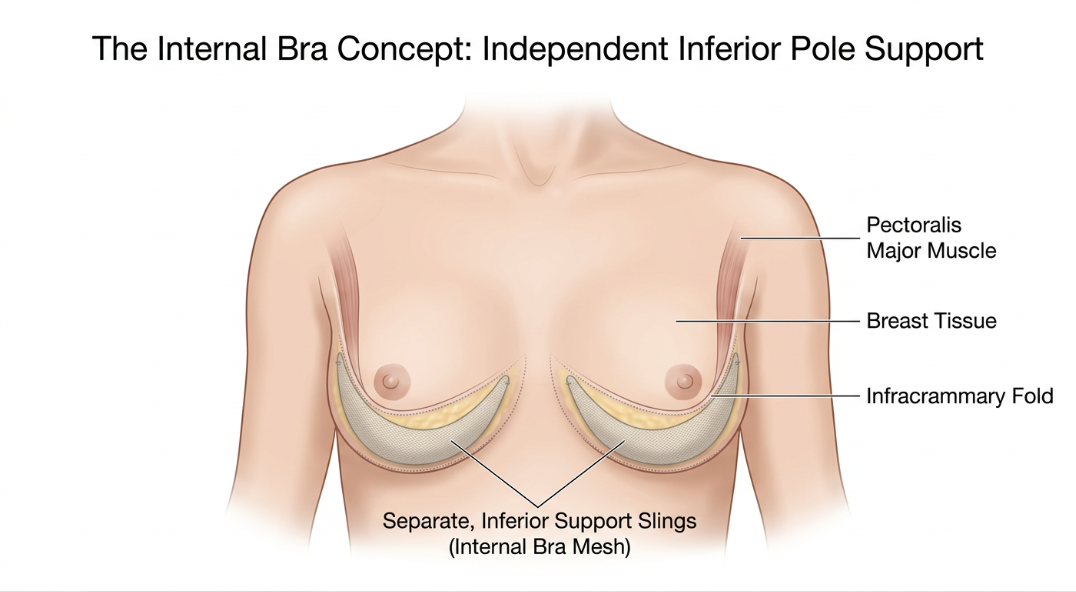
The internal bra technique doesn’t fight gravity with skin. It fights it with structure. By placing absorbable mesh or reinforced sutures inside the breast, the internal support structure takes on the load that skin cannot carry long-term.
Unlike conventional breast lifts, the internal bra technique provides internal structural support, functioning much like an invisible bra beneath the skin, resulting in a longer-lasting, natural-looking lift.
The internal bra works precisely because it shifts the burden of support from the patient’s tissue to a biocompatible scaffold that, as it dissolves, leaves behind a stronger collagen framework. The breast lift results are no longer dependent on stretched skin. They’re backed by the patient’s own regenerated internal architecture.
How the Internal Bra Improves Lift Outcomes
This is where the internal bra procedure delivers its clearest value, specifically in how it changes what a breast lift can achieve and how long it holds.
Longer-Lasting Results
Research from leading plastic surgery practices shows that patients maintain their lifted breast position for 10-15 years on average with the internal bra, compared to 5-7 years with conventional mastopexy techniques. That’s a meaningful extension, particularly for patients investing in cosmetic breast surgery with a long-term mindset.
Better Upper Pole Support
One of the most common complaints after traditional breast lifts is the gradual loss of upper breast fullness. The upper pole deflates first as gravity pulls tissue downward. The internal bra support specifically targets the lower pole and breast fold, which in turn stabilises upper pole fullness and prevents the slow descent that undermines long-term lift or augmentation results.
Stronger Foundation for Implants
When combining a lift and augmentation, the internal bra creates a stable foundation that breast implants can sit against. For patients combining a breast lift with implants, the internal bra offers additional structural support, helping prevent implant displacement, bottoming out, or lateral drifting. Without it, implant placement in weakened breast tissue carries a meaningfully higher risk of long-term complications.
How It Compares to a Traditional Lift
| Factor | Traditional Breast Lift | Internal Bra Breast Lift |
|---|---|---|
| Primary support mechanism | Own skin and natural tissue | Internal mesh bra or suture scaffold |
| Upper breast fullness longevity | Moderate, diminishes over time | Better maintained long-term |
| Implant support | Relies on patient’s tissue alone | Reinforced internal sling supports implants |
| Revision likelihood | Higher over 5-10 years | Significantly reduced |
| Result duration | 5-7 years average | 10-15 years average |
| Candidate requirement | Good skin elasticity preferred | Suits weakened breast tissue and loose tissue |
| Recovery difference | Standard | Comparable; no significant added downtime |
The Internal Bra in Revision Surgery
This is arguably where the internal bra technique earns its strongest case. Revision surgery is harder than primary breast augmentation. Tissue quality is compromised. Scar tissue is present. The implant pocket may be stretched, distorted, or in the wrong position entirely.
The internal bra is frequently used in implant revision surgery, particularly for women who have experienced complications such as implant rupture, capsular contracture, or displacement. Revision surgery can be complex, as the breast tissue may already be compromised from a previous augmentation. The internal bra provides the additional support needed to achieve successful revision outcomes, stabilising the implant pocket and reducing the risk of future complications.
Specific Revision Scenarios Where It Fits
- Implant malposition: When a breast implant has migrated out of its intended position, the internal bra creates a new, reinforced breast fold and pocket boundary that holds the implant placement correctly
- Bottoming out: Where the implant drops below the inframammary fold due to weakened tissue, the internal sling literally rebuilds the floor of the breast pocket
- Implant displacement or lateral drift: The internal bra support acts as a boundary, preventing the breast implant from migrating outward over time
- Recurrent sagging after a previous lift: For patients who have already had one breast lift and are experiencing ptosis again, adding internal bra materials during revision surgery addresses the root cause rather than repeating the same approach with the same limitations
An important distinction: in cosmetic breast surgery, acellular dermal matrix (ADM) is not typically a first-line option. In practice, biosynthetic mesh is usually the more practical choice when added internal support is needed. ADM is generally reserved as a last-resort option in more complex reconstructive settings, such as breast cancer reconstruction or recurrent capsular contracture.
Explore our breast revision page to understand how we approach these cases at Aestira.
Which Internal Bra Material Is Right for You
The internal bra depends on more than just your anatomy. It depends on your surgical history, your goals, and the specific approach your surgeon uses to create internal support that works for your tissue.
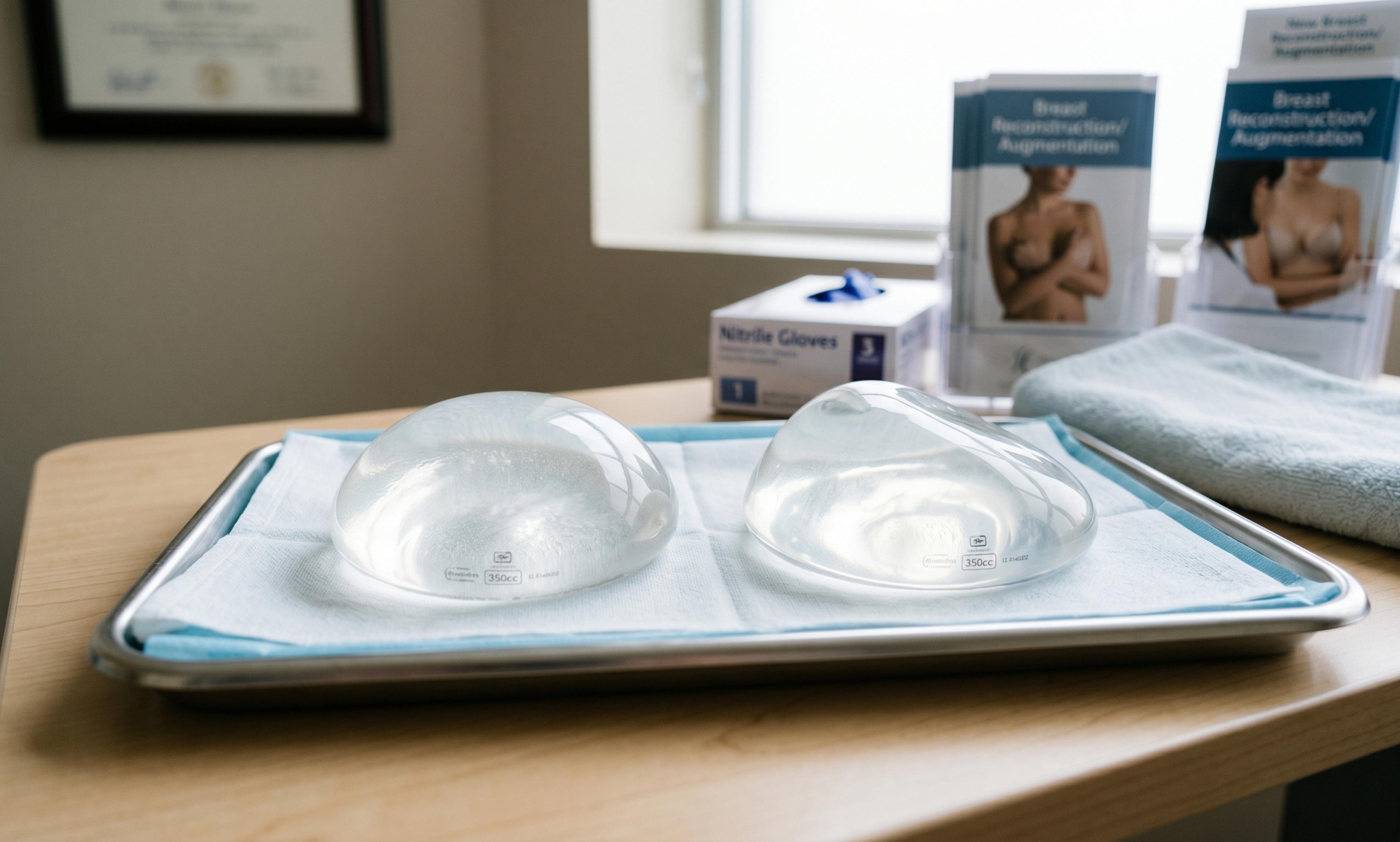
There are three main ways a mesh bra or internal support is constructed:
| Material | What It Is | Best Suited For |
|---|---|---|
| Absorbable synthetic mesh (e.g., GalaFLEX) | Polymer-based scaffold; dissolves over 18-24 months while own tissue builds around it | Primary breast lift, breast augmentation, lift or augmentation combinations |
| Acellular dermal matrix (ADM) | Biologic material derived from donated tissue; integrates with own tissue permanently | Breast cancer reconstruction and select recurrent capsular contracture cases; not routine cosmetic use |
| Internal sutures | Reinforced stitching anchored to chest wall; no foreign material added | Mild cases needing a bra procedure with minimal intervention |
A 2025 systematic review in the Aesthetic Surgery Journal found P4HB scaffolds to be safe, well-tolerated, and effective across a variety of breast surgery applications, with high patient satisfaction and strong tissue incorporation.
In cosmetic patients, GalaFLEX is often preferred because it is more cost-effective than ADM, while ADM is generally reserved for select reconstructive cases rather than routine cosmetic use.
Patient safety is the primary filter in this decision. A reconstructive surgeon specialising in revision breast procedures will weigh:
- Whether your own tissue can integrate effectively with the synthetic mesh
- Whether prior scar tissue from other breast surgeries creates complications for mesh placement
- Whether there is a reconstructive history or recurrent capsular contracture that makes ADM worth considering at all, or whether biosynthetic mesh remains the better fit
The bra procedure extends beyond breast lift and augmentation. It’s also used in breast reduction cases where significant tissue removal leaves the lower pole vulnerable to long-term ptosis, and in breast reconstruction where rebuilding internal architecture from scratch demands the most robust structural support available.
Pro tip: If your surgeon recommends a specific material without explaining why it suits your anatomy over alternatives, ask them to walk through the reasoning. The choice of internal bra materials is not interchangeable, and the right call for one patient is not automatically right for another.
Who Benefits Most and Who Doesn’t
The internal bra is not universally recommended. A good candidate for an internal bra procedure has specific characteristics. So does a poor one.
Strong Candidates
- Patients with naturally thin or weakened breast tissue that cannot support implants or a lift on its own
- Women who have experienced significant weight loss, leaving stretched skin and depleted breast volume
- Patients combining lift or augmentation with larger breast implants, where soft tissue needs reinforcement against the added weight
- Anyone with a history of implant displacement, bottoming out, or implant malposition in prior breast procedures
- Patients undergoing revision surgery where the original breast fold, pocket, or tissue quality has been compromised
- Women wanting maximum longevity from their cosmetic breast surgery investment
Less Ideal Candidates
- Patients planning future pregnancies, which can compromise breast position, regardless of internal bra support
- Those with active infections or significantly compromised healing capacity
- Patients with mild ptosis and strong, elastic own skin, where traditional breast lifts alone deliver durable results
- Anyone whose tissue quality assessment indicates that internal bra materials would not integrate effectively
Even patients with good skin elasticity can benefit from the internal bra technique, as it serves as insurance against premature breast sagging. But it’s worth an honest conversation about whether the added investment is justified for your specific anatomy.
Most patients fall somewhere in the middle. That’s precisely why a thorough surgical plan, based on tissue quality assessment and your full surgical history, is essential before committing to either approach.
Questions to Ask Your Surgeon

The right surgeon will welcome these questions. If they don’t, that tells you something, too.
Is a board-certified or board-eligible plastic surgeon performing this procedure?
Internal bra surgery adds complexity to an already technical procedure. Confirm your surgeon holds board certification in plastic surgery with residency training in plastic surgery specifically. Not all cosmetic surgery credentials are equivalent.
Is the internal bra safe for my specific tissue quality?
Whether internal bra surgery is safe and appropriate depends heavily on your individual tissue. Ask your surgeon to explain how they assessed your skin quality, breast tissue, and surgical history before making this recommendation.
What material are you recommending and why?
Surgical mesh, absorbable mesh, acellular dermal matrix, and internal suturing all achieve different things. Ask specifically why one approach suits your anatomy over another, and what the absorption or integration timeline looks like.
How does this affect my recovery compared to a standard lift?
For most patients, recovery from an internal bra breast lift is comparable to a standard breast lift. Expect a supportive surgical bra requirement, restrictions on heavy lifting for several weeks, and pain medication during the first few days. Ask your surgeon what’s different in your specific case.
Does your practice include post-surgical wellness support?
Recovery quality affects long-term outcomes. Ask whether integrative wellness protocols are part of your post-operative plan, including inflammation management and biostimulation therapies that go beyond standard post-op instructions.
What does this mean for my revision risk long-term?
Patient satisfaction with breast surgery is closely tied to how long the results hold. Ask your surgeon directly what revision likelihood looks like with and without the internal bra, and what patient satisfaction data their practice has from internal bra procedures specifically.
At Aestira, Dr. Zeng addresses every one of these questions during your consultation, giving you a clear, honest view of whether the internal bra fits your surgical plan before you commit to anything.
Longer-Lasting Lift Results Start With a Conversation at Aestira
The internal bra doesn’t replace a great breast lift. It makes one last significantly longer. Whether you’re planning your first lift, combining procedures, or correcting previous results, understanding this technique before your consultation puts you in a stronger position to ask the right questions.
Key takeaways:
- Traditional breast lifts rely on skin tension alone, which weakens over time with natural aging and gravity
- The internal bra technique shifts support from the own skin to a biocompatible internal scaffold
- Results with the internal bra last 10-15 years vs. 5-7 years with traditional breast lifts
- It’s most valuable in revision surgery, lift or augmentation combinations, and weakened breast tissue cases
- Material choice usually centers on absorbable mesh or sutures in cosmetic patients, while ADM is generally reserved for select reconstructive or recurrent capsular contracture cases.
- A board-certified or board-eligible plastic surgeon with residency training in plastic surgery is non-negotiable for this procedure
- Post-surgical wellness protocols directly influence how well internal bra materials integrate and how quickly you recover
Dr. Zeng evaluates every breast lift and revision case at Aestira with the internal bra as part of the surgical planning conversation from day one. Our $30 consultation gives you a clear, honest answer on whether this technique belongs in your plan. Book yours here.
FAQs
Is an internal bra better than a breast lift?
Not better; it enhances a breast lift. The surgical technique adds long-term support via supportive mesh, improving implant position and longevity beyond what a traditional lift achieves alone.
How much does a breast lift with internal bra cost?
Costs vary by surgical technique, mesh material, and whether breast lift, augmentation, or breast reduction is combined. Consult a board-certified plastic surgeon for an accurate, all-inclusive quote.
How long does a breast lift with an internal bra last?
Many patients maintain results for 10-15 years. Long-term support from the internal scaffold outlasts traditional lifts significantly, though aging and weight changes still affect outcomes over time.
What is the newest breast lift technique?
The internal bra breast lift is among the most advanced surgical techniques available. A board-certified plastic surgeon uses supportive mesh to create long-term support from within, reducing revision rates meaningfully.
Can the internal bra be used in breast reduction surgery?
Yes. The surgical technique is used in breast reduction to reinforce the lower pole after tissue removal, helping many patients maintain breast shape and implant position long term.
Does the internal bra affect recovery compared to a standard lift?
Recovery is comparable. A board-certified plastic surgeon will recommend a supportive surgical bra, restrict heavy lifting, and manage discomfort with pain medication during the first few weeks.