Asian eyelid surgery is one of the most requested cosmetic procedures worldwide. Yet it’s also one of the most misunderstood. Some people think it’s about looking less Asian. It’s not. It’s about creating a defined crease that enhances your natural eye shape while keeping your ethnic identity intact.
In this guide, we’ll cover:
- What Asian eyelid surgery actually is (and what it isn’t)
- How the procedure works step by step
- Expected results and realistic timelines
- Recovery, costs, and how to choose the right surgeon
At Aestira, we specialize in ethnic plastic surgery that honors your natural features. Dr. Waylon Zeng brings a culturally informed approach to every procedure, so results always look like you.’
What Asian Eyelid Surgery Actually Is
Asian eyelid surgery (also called Asian blepharoplasty or double eyelid surgery) is a cosmetic procedure that creates or enhances a crease in the upper eyelid. It’s one of the most frequently requested cosmetic surgeries in Asia, and the third most popular cosmetic procedure globally after rhinoplasty and breast augmentation.
Here’s the thing most people get wrong: this procedure is not about looking Western. The first double eyelid surgery was performed in 1896 by a Japanese surgeon named Mikamo, long before Western beauty standards had any influence on Asian culture. His goal was simply to enhance expressiveness within existing Japanese aesthetics.
The surgery focuses on one key structural detail: the supratarsal crease.
Monolid vs. Double Eyelid
Roughly 50% of people of Asian descent have monolids, meaning their upper eyelid has no visible crease. The other half naturally have some form of a double eyelid, though the crease tends to sit lower compared to Caucasian eyes.
Neither is better. Neither is worse. They’re simply different expressions of eyelid anatomy. But for those who want a defined crease, whether for makeup application, a brighter appearance, or correcting asymmetry, Asian eyelid surgery offers a permanent solution.
Why People Get It
The reasons are more varied than you’d think:
- Makeup application. A visible crease gives eyeshadow and liner a surface to sit on.
- Brighter, more open look. A defined fold can make the eyes appear larger and more awake.
- Eyelid asymmetry. Some patients have a crease in one eye but not the other.
- Lash irritation. In some cases, a monolid causes eyelashes to press against the eye.
Pro tip: If you’ve been using eyelid tape or glue to create a temporary crease every morning, surgery can give you that look permanently, without the daily 15-minute routine.
What It’s Not
Asian eyelid surgery is not an attempt to erase your ethnicity. A skilled surgeon, like Dr. Waylon Zeng at Aestira, designs the crease height, shape, and depth to complement your specific facial anatomy. The goal is enhancement that still looks like you, not a copy-paste of someone else’s eyes.
How the Procedure Works Step by Step
Every successful corrective Asian blepharoplasty starts before you ever enter a surgery center. Here’s how the full process unfolds, from your initial consultation to the final suture.
The Consultation
Your surgeon will evaluate your individual anatomy during the initial consultation. This means assessing your eyelid skin thickness, the position of your existing anatomy (or lack of a crease), the presence of an epicanthal fold near the inner corner of your eye, and any excess upper eyelid skin or bulging fat that may need to be addressed.
You’ll discuss your goals openly. Do you want a subtle, low-set lid crease? A more defined double eyelid crease? Correction of asymmetry where one eyelid has a fold, and the other doesn’t? This conversation shapes the entire surgical plan.
Pro tip: Bring reference photos showing the type of crease you like, but understand that your results will be tailored to your own eyelid structures and facial proportions, not copied from someone else’s face.
Choosing Your Technique
There are two primary surgical techniques for Asian double eyelid surgery. The right one depends on your anatomy, your goals, and how permanent you want the results to be.
| Incisional Method | Non-Incisional (Suture) Method | |
|---|---|---|
| How it works | A small incision is made along the planned crease line; excess skin, excess fat, and eyelid tissues are removed as needed | Buried sutures are placed through tiny puncture points to create fibrous attachments between the skin and the deeper muscle |
| Best for | Asian patients with thicker skin, sagging skin, or excess fat on the upper eyelid | Younger patients with thinner eyelid skin and minimal excess tissue |
| Permanence | Long-lasting, often permanent | May fade over 5-10 years |
| Recovery | Slightly longer (more tissue work involved) | Faster (no major incision lines) |
| Scarring | Fine line hidden within the new eyelid crease | Virtually no visible scar |
Some surgeons also offer a hybrid approach, combining a small incision with strategic suture placement for patients who fall somewhere in between.
Day-of-Surgery Walkthrough
Here’s what to expect when you arrive at the surgery center:
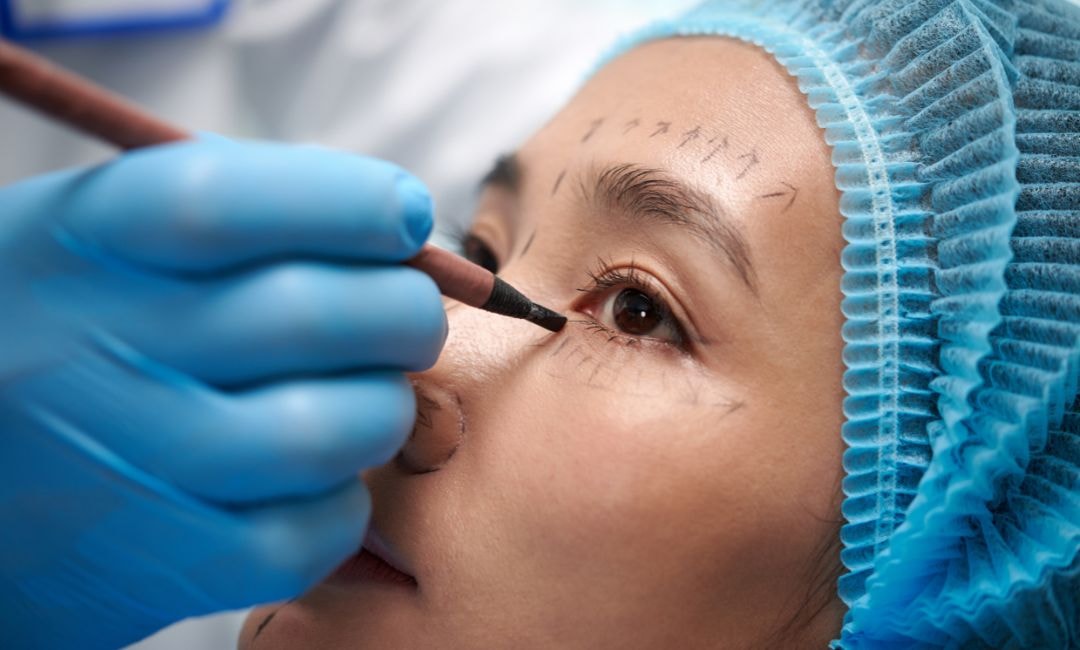
- Pre-op marking. Your surgeon marks the planned crease formation on your upper lid while you’re sitting upright. This is critical, because gravity affects where the eyelid fold naturally falls. The markings are then verified when you lie down.
- Anesthesia. Most Asian eyelid surgery is performed under local anesthesia, sometimes with light IV sedation. You’re awake but completely numb and comfortable.
- The procedure itself. Depending on the technique, your surgeon either makes a precise incision along the marked line or places buried sutures through small puncture sites. For incisional cases, excess skin, muscle, and fat are carefully removed. The skin is then sutured to the deeper eyelid structures (the levator aponeurosis or tarsal plate) using suture material that creates the new eyelid crease.
- Closure. Incision lines are closed with fine sutures. The entire procedure typically takes 30 to 60 minutes per eye.
That’s it. No overnight stay. Most patients head home within a couple of hours.
At Aestira, Dr. Waylon Zeng leads every stage of your procedure personally, from the initial consultation markings to the final closure. That one-surgeon continuity matters because the person who designs your crease should be the same person creating it.
Expected Results and Realistic Timelines
Asian eyelid surgery delivers natural-looking results, but those results don’t appear overnight. Your eyelids need time to heal, settle, and reveal their final shape.
What You’ll See (And When)
The timeline surprises many patients. Here’s a realistic breakdown:
- Day 1-3: Swelling peaks. Your upper eyelid will look puffy, and the double eyelid crease will appear unnaturally high. This is normal. The eyelid is swollen, not poorly positioned.
- Day 5-7: Suture removal (for incisional cases). Bruising shifts from purple to yellow-green. You can start to see the beginnings of your new crease shape.
- Week 2-3: Most patients feel comfortable being seen in public. Bruising fades significantly. The crease is still settling.
- Month 1-2: The double fold begins to look more natural. Swelling continues to decrease, and the crease height gradually lowers to its intended position.
- Months 3-6: This is when your final results truly emerge. Scars soften and blend into the natural eyelid fold. The visible eyelid crease reaches its permanent position.
In some cases, particularly with thicker eyelid skin common in Asian individuals, residual swelling can linger for up to a year before fully resolving.
Pro tip:Take weekly photos of both eyes in the same lighting for the first 8-12 weeks. Tracking your progress visually prevents the “it’s too high” panic that many patients feel during the first few weeks. The crease will drop as swelling resolves.
What “Natural” Actually Looks Like
A well-performed Asian upper blepharoplasty doesn’t scream “I had surgery.” It simply looks like you were born with a defined eyelid crease. Your almond-shaped eye structure stays intact. Your eye appearance retains its natural character.
The crease style also matters. There are two main shapes:
- Infold (tapered) crease: The crease begins inside the epicanthal fold near the inner corner and fans outward. This is the most naturally present style among Asian individuals who are born with a double eyelid.
- Outfold (parallel) crease: The crease runs parallel above the lash line, more visible from corner to corner. This creates a more open, defined look.
Neither is inherently better. The right choice depends on your existing anatomy, your facial proportions, and what feels like you.
What Won’t Change
It’s equally important to know what this cosmetic procedure doesn’t do. Asian blepharoplasty:
- Won’t dramatically change the shape of your eye
- Won’t correct significant drooping caused by ptosis (a separate muscle issue)
- Won’t address concerns with the lower eyelid or lower lid area (that requires other procedures)
- Won’t eliminate deep wrinkles around the eye
If you have additional concerns, like a heavy brow weighing down the upper half of your eyelid, your surgeon may recommend combining procedures for optimal results.
Recovery, Costs, and Choosing a Surgeon
This is where the practical details live. How much downtime do you really need? What does Asian eyelid surgery cost? And how do you find the right plastic surgeon for a procedure this nuanced?
Recovery: Week by Week
Recovery from Asian blepharoplasty is relatively straightforward, but it pays to plan ahead.
- Week 1: Rest mode. Swelling and bruising are at their peak in the first few days. Cold compresses, head elevation, and lubricating eye drops are your best tools. Most patients have suture removal around day 5-7. Avoid bending over, lifting heavy objects, and any strenuous activity. If you wear contacts, switch to glasses for at least 1-2 weeks.
- Weeks 2-3: Back to the world. Most patients return to work and social activities around day 10-14. Residual bruising can be covered with light makeup (once your surgeon approves). The eyelid still feels a bit tight, and you may notice mild asymmetry between sides. That’s normal. Each eye heals at its own pace.
- Weeks 4-6: Gradual return to normal. You can typically resume exercise and more strenuous activity by week 3-4 with your surgeon’s clearance. The crease continues settling, and the upper lid appearance improves noticeably each week.
- Months 3-6: Final results. Scars flatten and fade. The double fold reaches its permanent position. Most patients see their final results within this window.
Things to avoid during recovery:
- Rubbing your eyes (this can disrupt crease formation)
- Upper eyelid makeup and false lashes with lash glue
- Eyelid tape or adhesive products on the healing skin
- Direct sun exposure without sunglasses or SPF
- Smoking, which slows blood flow and delays healing
What Does It Cost?
Asian eyelid surgery cost varies widely depending on your location, surgeon, and the complexity of your case. Here’s a general snapshot of pricing in the United States:
| Factor | Typical Range |
|---|---|
| Non-incisional (suture) method | $2,500 – $5,000 |
| Full incisional method | $3,000 – $8,000 |
| Epicanthoplasty (add-on) | $2,000 – $3,000 |
| Anesthesia + facility fees | $500 – $2,000 |
Keep in mind, these numbers reflect the aesthetic procedure portion only. Your total may also include the initial consultation fee, follow-up visits, and any prescribed medications.
What influences the price?
- The surgical techniques used (incisional costs more than suture-based)
- Whether excess skin, excess fat, or epicanthal fold correction is involved
- Your surgeon’s level of extensive training and specialization in facial plastic surgery
- Geographic location (major metro areas tend to cost more)
Most insurance plans treat this as a cosmetic procedure and won’t cover it. However, if sagging skin on your upper eyelid is obstructing your vision, you may have a case for medical necessity. It’s worth checking with your provider.
Financing. Many practices offer payment plans through services like CareCredit and PatientFi. At Aestira, both options are available, and consultations are just $30, making it easy to explore your options without a major upfront commitment.
Choosing the Right Surgeon
This is the most important decision you’ll make. Asian blepharoplasty is not the same as standard upper blepharoplasty. The anatomy is different. The eyelid structures are different. The goals are different. A surgeon who routinely performs eyelid surgery on non Asian eyelids may not fully understand the nuances of crease formation in Asian patients.
What to look for:
- Board certification in plastic and reconstructive surgery (or board eligibility), with training completed in a plastic surgery residency. This is your baseline.
- Specific experience with Asian eyelid surgery. Ask how often they perform this procedure. Look at before-and-after photos of real Asian patients, not just general upper blepharoplasty cases.
- A culturally informed approach. The best surgeons understand that the goal isn’t to create a “Western” eyelid. It’s to enhance your natural features. Pay attention to how they talk about ethnic nuances in facial plastic surgery and reconstructive surgery.
- Holistic post-op care. Recovery isn’t just about stitches and ice packs. Ask about wellness protocols designed to minimize swelling and inflammation after surgery. Aestira’s wellness program includes customized recovery protocols, nutritional guidance, and biostimulation therapies that support faster healing.
Questions to ask at your consultation:
- Are you a board-certified or board-eligible plastic surgeon?
- How many Asian double eyelid surgeries have you performed?
- Which technique do you recommend for my anatomy, and why?
- What does your recovery support look like?
- Can I see before-and-after photos of Asian patients with a similar single eyelid or eyelid type to mine?
Red flags to watch for:
- A surgeon who pushes one technique for every patient (your procedure should match your individual anatomy)
- No before-and-after photos of Asian patients
- Vague answers about their training or experience with ethnic eyelid surgery
- No structured follow-up plan after surgery
Dr. Waylon Zeng at Aestira brings a culturally sensitive, patient-first approach to every Asian eyelid procedure. With special attention to ethnic and gender nuances, along with Aestira’s integrated wellness recovery protocols, you get more than a cosmetic procedure. You get a complete experience, from consultation through recovery, guided by the same surgeon every step of the way.
Your Eyes, Your Identity, Your Aestira
Asian eyelid surgery isn’t about changing who you are. It’s about refining what’s already there, on your terms, with results that honor your identity.
Here are the key takeaways:
- Asian blepharoplasty creates or enhances an upper eyelid crease while preserving your ethnic features
- Two main techniques exist: incisional (permanent) and non-incisional (less invasive, may fade)
- Final results take 3-6 months to fully settle, so set realistic expectations early
- Choosing a surgeon with specific experience in Asian eyelid anatomy is the most important decision you’ll make
- Recovery is manageable, with most patients back to daily life within two weeks
At Aestira, Dr. Waylon Zeng pairs surgical precision with a culturally informed eye, creating results that look and feel like you. From your $30 consultation through recovery with personalized wellness protocols, you’re guided by one surgeon the entire way.
FAQs
What’s the difference between blepharoplasty and Asian blepharoplasty?
Standard upper blepharoplasty typically removes excess skin and fat from aging eyelids. Asian blepharoplasty goes further by creating a new upper eyelid crease where one doesn’t exist, requiring specialized techniques that account for unique eyelid anatomy. Both oculoplastic surgeons and board-certified plastic surgeons may perform either procedure.
How does Asian eyelid surgery work?
The surgeon creates a double eyelid fold by connecting the skin to deeper eyelid structures using either an incisional method (small cut along the crease line) or a non-incisional suture method (buried stitches through tiny puncture points). Both are typically performed under local anesthesia.
How long does Asian eyelid surgery last?
Results from the incisional method are generally permanent. The suture method can last 5-10 years but may fade over time, especially in patients with thicker skin. Aging will still affect your eyelids naturally, regardless of technique.
Is there a surgery to get rid of Asian eyes?
No, and that’s not what this procedure is about. Asian eyelid surgery enhances your natural features by creating a defined crease. It does not erase ethnic characteristics. Historically, even Japanese women who first sought this procedure were motivated by expressiveness, not Westernization. Set realistic expectations: the goal is refinement, not transformation.
How common is eyelid surgery in Asia?
Very. Double eyelid surgery is the most requested cosmetic procedure across much of East Asia and ranks among the top three procedures requested by Asian Americans in the U.S. About 50% of people of Asian descent are born without a visible crease, which drives consistent demand for this procedure.