One has a crease. One doesn’t. And somehow, that tiny anatomical difference has sparked decades of cultural debate, beauty trends, and one of the most popular cosmetic procedures on the planet. About 50% of people of Asian descent have single eyelids, yet the conversation around them is rarely just about anatomy. It’s about identity.
This guide breaks it all down:
- The actual anatomical difference between double and single eyelids
- Why do some people have one type and not the other
- Cultural context and shifting beauty standards
- Makeup techniques for both eyelid types
- Surgical and non-surgical options if you want a change
At Aestira, we believe both eyelid types are beautiful. But if you’re considering a change, Dr. Waylon Zeng specializes in enhancing your natural features, never erasing them.
The Actual Anatomical Difference
The difference between monolids and double eyelids comes down to what’s happening beneath the skin of your upper eyelid. It’s not about size, shape, or attractiveness. It’s about connective tissue and where it attaches.
How a Double Eyelid Forms
In a double eyelid, the levator aponeurosis (the muscle that lifts your eyelid open) has fibrous attachments that connect directly to the skin. When your eye opens, that connection pulls the skin inward, creating a natural arc-shaped crease. This visible fold divides the eyelid into two sections: one above the crease and one below it, near the lash line.
That’s why it’s called a “double” eyelid. Not because there are two eyelids, but because there’s a visible crease that gives the appearance of a double fold.
How a Monolid Forms
In monolid eyes, those fibrous attachments are either absent, positioned differently, or less pronounced. Without that skin-to-muscle connection, the upper eyelid presents as a smooth, uninterrupted surface from the lash line to the brow bone. No fold. No crease. Just one continuous plane of skin.
Monolids also tend to have:
- More subcutaneous fat in the eyelid, particularly near the brow line
- A thicker eyelid overall compared to non Asian eyelids
- Epicanthal folds, a common feature where skin near the inner corner of the eye overlaps the tear duct area
Quick Comparison
| Double Eyelid | Single Eyelid (Monolid) | |
|---|---|---|
| Crease | Visible crease or defined contour above the lash line | No visible crease; smooth eyelid surface |
| Fat distribution | Fat sits at a more elevated position, above the crease | Fat extends lower, creating a fuller, flatter lid |
| Epicanthal folds | Less common | Commonly found, especially in East Asian features |
| Appearance when open | A defined crease separates the upper lid into two sections | Eyes may appear slightly smaller; monolids decrease the visible opening |
| Appearance when closed | Crease line still faintly visible | Smooth, even surface |
Pro tip: Monolids are not the same as hooded eyes. With hooded eyes, a crease exists but gets hidden when excess skin directly under the brow line folds over the top. With monolids, there’s no crease at all. Different anatomy, different solutions.
Why Some People Have One Type
If you’re wondering why your eyes look one way and your sibling’s look another, the answer is mostly written in your DNA.
It’s Genetics
The gene for double lids is considered dominant, while the monolid gene is recessive. That means if one parent carries the double eyelid gene and the other carries the monolid gene, the child is more likely to have a visible crease. But genetics aren’t always that clean-cut.
Two parents with double eyelids can still produce a child with monolids if both carry the recessive gene. And within the same family, it’s completely normal to see various shapes and eyelid types. One eye might even differ slightly from the other.
Ethnicity and Geography
Eyelid anatomy varies across populations. About 50% of people of Asian descent have monolids, but the distribution isn’t uniform. Monolids are most commonly found among people of East Asian descent, particularly those of Korean, Chinese, Japanese, and Mongolian heritage. Southeast Asians tend to have double lids more frequently. Native American and hispanic populations commonly have a variation of monolids as well.
But here’s what many people overlook: monolids are not exclusive to Asian eyes. They can appear in people of virtually any ethnic background, and epicanthic folds are also a naturally present feature in young children of all races before the nasal bridge fully develops.
Age Can Change Things
Your eyelid shape isn’t always permanent. Some people are born with monolids and gradually develop a faint crease as they age due to changes in skin elasticity, fat redistribution, or loss of connective tissue. Others who had a defined crease may find it disappearing under sagging skin as the years go by.
This is not a person’s imagination. Eyelid anatomy genuinely shifts over time.
Cultural Context and Shifting Standards
Let’s talk about the elephant in the room. The monolid vs double eyelid conversation has never been just about anatomy. It’s layered with cultural perceptions, historical influence, and evolving beauty standards that vary widely across the globe.
The Double Eyelid Preference
For decades, double eyelids have been favored in many cultures, particularly across East Asia. Double eyelid surgery has been the most requested cosmetic procedure in countries like South Korea, where it became a common procedure as early as the 1960s. The reasons are complex. Some attribute the preference to Western media influence. Others point to longstanding local aesthetic preferences that predate any Western contact.
What’s clear is that the preference was never universal. And it’s changing.
The Monolid Movement
In recent years, cultural perceptions around monolids have started shifting in a meaningful way. Celebrities and public figures with monolids have gained massive visibility, particularly through K-pop and global entertainment. The message is evolving from “fix your eyes” to “your eyes are already beautiful.”
Beauty brands have also adapted. Many cultures now see makeup lines designed for monolid eyes rather than around them. The idea that one eyelid shape is inherently more attractive is losing ground, replaced by a broader celebration of natural beauty in all its forms.
Where We Are Now
The truth sits somewhere in the middle. Beauty standards still influence aesthetic preferences, and double eyelid surgery remains a common procedure across Asia and among Asian communities worldwide. But the why behind the decision matters. More people are choosing surgery not to look like someone else, but to enhance what they already have, on their own terms.
And that shift makes all the difference.
Makeup Techniques for Both Types
Whether you have monolids, double lids, or something in between, eye makeup works differently depending on your eyelid anatomy. The trick isn’t forcing your eyes to look like someone else’s. It’s learning makeup techniques that work with your shape to create depth, definition, and dimension.
For Monolid Eyes
The biggest challenge with monolids? Product transfer. Because the eyelid folds over itself when the eye opens, eyeshadow and eyeliner can smudge or disappear within minutes.
Here’s how to work around that:
- Always prime your lids. A tacky, waterproof eye primer is non-negotiable. It prevents shadow from creasing and gives your products something to grip.
- Use waterproof formulas. This applies to eyeliner and mascara. Gel and liquid liners hold up better than pencil on a smooth lid surface.
- Apply a shadow higher than you think. Since the lid folds inward, place eyeshadow above your natural crease line so it’s still visible when your eyes are open. This is how you add depth to an otherwise flat canvas.
- Focus on the outer corners. Building color at the outer edge of your eye creates a lifted, elongated effect that flatters the natural almond-shaped eye.
- Curl your upper lashes. Monolid lashes often point downward or straight out. A heated lash curler followed by waterproof mascara keeps them lifted all day.
- Try tightlining. Line your upper waterline with a dark pencil to create depth and make your lash line appear fuller without adding bulk to the lid.
For Double Eyelids
A visible crease gives you more visible lid space to work with, but it comes with its own nuances, especially if your crease is shallow or your eyelid leans toward hooded eyes.
Key techniques:
- Define the crease, don’t overpower it. Use a matte shade slightly darker than your skin tone along the eyelid crease to add depth. Blend well for a seamless transition.
- Keep eyeliner thin. A thick line can overwhelm a defined crease and make the lid space look smaller. A fine wing along the lash line with a slight flick outward works beautifully.
- Highlight the center. A shimmer or metallic shadow at the center of the lid draws light and makes the eye pop.
- Don’t skip the brow bone. A subtle highlight just below the brow bone opens up the upper half of the eye area.
- Layer carefully. With deep-set eyes and a prominent crease, shadow can settle into the fold. Blend in thin layers and set with primer.
Pro tip:Regardless of eyelid type, always do your eye makeup before the rest of your face. It’s much easier to clean up fallout on bare skin than over a finished foundation.
Surgical and Non-Surgical Options
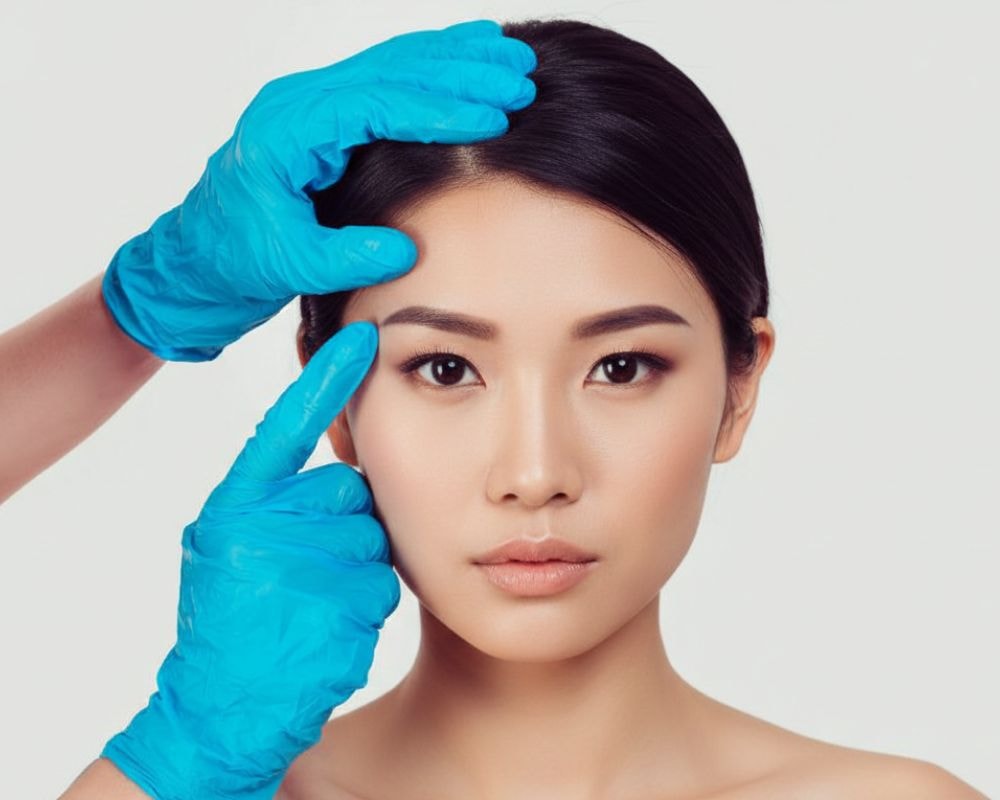
Both monolids and double eyelids are natural, healthy variations of eyelid anatomy. Neither needs to be “fixed.” But if you’re considering a change, whether for cosmetic reasons, functional concerns, or personal preference, here’s what’s available.
Non-Surgical Options
These are temporary and reversible. They’re a good starting point if you want to test the look of a crease before committing to anything permanent.
- Eyelid tape or adhesive strips. Applied to the upper eyelid to create a temporary fold. Popular across East Asia, but daily use over months or years can irritate delicate eyelid skin, cause stretching, or trigger allergic reactions.
- Eyelid glue. Similar concept, slightly different application. Creates a temporary crease by bonding the skin to itself. Easier to customize than tape, but can look unnatural if applied too thickly.
- Fiber strips. Thin, nearly invisible fibers that pull the skin into a crease shape. Less bulky than tape, but it can be tricky to apply.
These non-surgical methods are fine for occasional use, but they’re not long-term solutions. If you find yourself relying on tape or glue every single morning, it might be worth exploring a more permanent change.
Surgical Options
For a lasting result, double eyelid surgery (blepharoplasty) is the gold standard. It’s one of the most commonly performed cosmetic procedures in the world and creates a permanent eyelid crease that looks and functions naturally.
There are two main approaches:
Incisional method. A small incision is made along the planned crease line. The surgeon can remove excess skin, excess fat, and adjust eyelid tissue before suturing the skin to deeper structures to create a defined crease. This is best for patients with thicker skin, more tissue, or those who want a permanent change. Scars are fine and typically hidden within the fold.
Non-incisional (suture) method. Buried sutures are placed through tiny puncture points to form the crease without a full incision. Recovery is faster, but results may soften over time, especially in people with heavier eyelid tissue.
Additional procedures that may complement monolid surgery:
- Epicanthoplasty. Addresses prominent epicanthal folds at the inner corner of the eye for a wider, more open eye appearance.
- Ptosis repair. Corrects a drooping upper lid caused by a weak levator muscle, which is a separate issue from not having a crease.
What to Know Before You Decide
If you’re exploring surgical options, choose a board-certified or board-eligible plastic surgeon with specific training in Asian eyelid anatomy. This is not a one-size-fits-all cosmetic surgery. The goal of a successful procedure isn’t to create a Caucasian appearance. It’s to enhance your existing anatomy while preserving your unique characteristics.
At Aestira, Dr. Waylon Zeng specializes in ethnic plastic surgery that respects and enhances your natural features. Whether you’re considering double eyelid surgery or simply exploring your options, every consultation starts with understanding your goals, not a template. And with Aestira’s integrated wellness recovery protocols, you get support that goes beyond the operating room, from nutritional guidance to biostimulation therapies designed to minimize swelling and speed up healing.
Consultations are just $30. It’s a low-pressure way to ask questions, explore techniques, and see if surgery aligns with what you’re looking for.
Love Your Eyes, Enhance Them at Aestira
Monolids and double eyelids are two expressions of the same anatomy. Neither is a flaw. Neither needs fixing. But if you want to make a change, you deserve a surgeon who understands the difference.
Here’s what to remember:
- The difference between monolids and double lids comes down to connective tissue attachments beneath the skin
- About 50% of people of Asian descent have monolids, and the trait is primarily genetic
- Beauty standards around eye shape are shifting toward celebrating both types
- Makeup techniques differ significantly between eyelid types, so learn what works for yours
- Surgical and non-surgical options exist, but choosing the right surgeon matters most
If you’re considering double eyelid surgery, Aestira is built for exactly this kind of decision. Dr. Waylon Zeng combines surgical precision with cultural sensitivity, and Aestira’s wellness recovery program supports your healing from day one.
FAQs
Is a single or double eyelid better?
Neither is better. Both are healthy, natural variations of eyelid anatomy. Your eye shape is determined by genetics, not by a ranking system. The “better” eyelid is whichever one makes you feel confident. If you’re considering a change, it should be your choice, not a response to pressure.
Do all Caucasians have double eyelids?
No. While double eyelids are more common in Caucasian populations, not everyone has them. Hooded eyes, low-set creases, and even absent creases exist across all ethnicities. Eye shape varies widely within every racial group. The idea that double eyelids belong to one ethnicity is a misconception.
Why do double eyelids look “better”?
They don’t, objectively. This perception is largely shaped by cultural beauty standards and media representation, not by any inherent superiority.
In many cultures, monolids are celebrated for their elegance and uniqueness. What looks “better” depends entirely on personal and cultural aesthetic preferences, and those are always evolving.
What are the benefits of double eyelids?
From a practical standpoint, a double eyelid appearance can make eye makeup application easier because there’s more visible lid space to work with. Some people also feel their eyes look more open or expressive with a defined crease.
But these are cosmetic preferences, not medical benefits. If you’re exploring plastic surgery to create a crease, focus on finding a specialist who prioritizes natural results that honor your unique eye shape.